
The most valuable products target customer pains.
A persona is a fictional, research-based profile that represents one segment of your target customers, built to capture how that person relates to your product rather than just who they are demographically. A market segment stays at the level of shared traits (age, industry, company size); a persona goes further and gives that segment a face, grounded in real research rather than guesswork. Building one forces you to translate abstract market data into a single person's goals, pains, and behavior, which makes it far easier for a product, design, or marketing team to make decisions that actually fit the people they are building for. Whether you are pre-seed or prepping for Series A, the exercise works the same way. It is typically the starting point of Step 2 in our Idea to Pitch methodology. Use the template below to build your own.
What is a Persona
Personas make it easier to empathize with an audience group, understand what they need, and design the right solution for them. They are built from real research, not assumption: demographic and behavioral data collected from the target market, distilled into shared values, goals, and behaviors. A company then uses that persona to decide what to build and how to talk about it in a way that resonates with that specific group.
There are several types of personas, depending on what they are built for.
Types of Personas
The three most common types differ by how they are built and what decision they are meant to drive.
Proto-Personas
This group of personas is used when persona-based research is not possible, whether due to time and money constraints, or for other practical reasons. In such cases, the team creating the persona utilizes secondary research and any other available information to come up with the personas' profiles. This approach can be effective in driving initial product design decisions but market validation remains important. For that reason, it is recommended to revisit and refine the Personas once related information is collected from the market.
Design Personas
When defining this group of personas, the focus is on users' current behavior, goals, and pain points. The profiles of design personas are based on field research and they describe why the customers do what they do. They can be used to make product decision for that customer segment. Using design personas ensures that everyone involved in designing and building the product understands the target market and considers them throughout the product development process. This group of personas is effective in communicating research insights, defining a product, and understanding the type of users to focus on.
Marketing Personas
When defining this group of personas, the focus is on demographic information, shopping behaviors, buying motivations and concerns, media habits, and marketing messages. Typically, marketing personas are described as a range and explain the customer's behavior. For instance, 20-35 years old males, living in the US and Canada. Given the precise description of the customer, marketing personas are effective in determining the kind of customers who will be receptive to certain messages or products, and assessing the potential ROI of a product. However, they are not effective in defining a product or service in terms of how it works, its use, or features that need priority.

Persona Creation
Personas are ideally created based on real data from market research. First the data is collected, then the (market) segments are identified based on the data, and lastly the personas are created to match the segments.
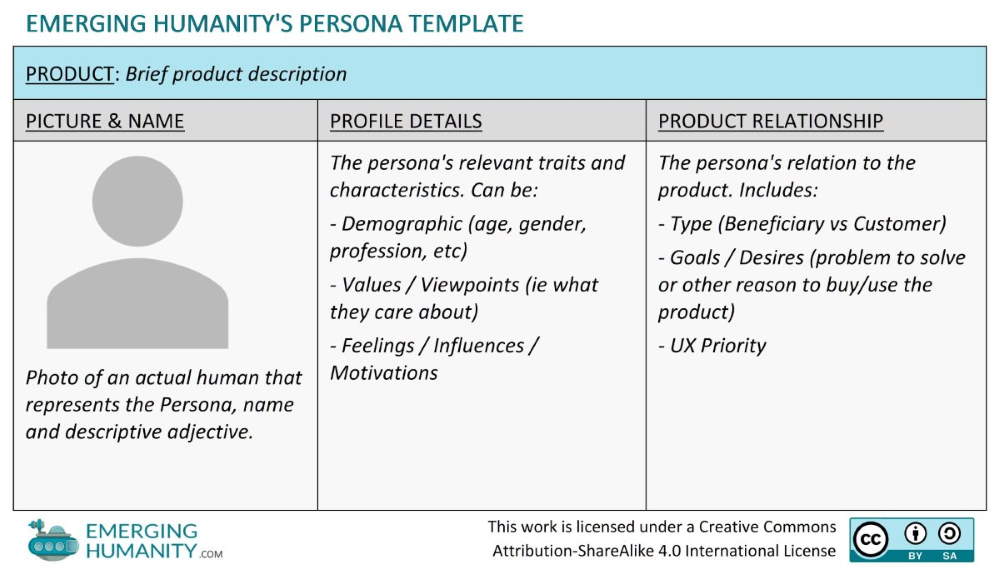
A Product (Design) Persona includes
- Demographic info if it relates to customer behavior towards the product
- Values / Viewpoints (ie what they care about)
- Feelings / Influences / Motivations
- Goals / Desires they want to achieve
Additionally all Personas are given
- An adjective that describes a key characteristic of the persona
- A name whose first (or first two) letters are the same as the adjective's
- A photo that represents the persona
Beneficiary (User) vs Paying Customer
An important consideration when creating personas is the distinction between the user and the customer. While the user (or beneficiary) is the person who enjoys the benefits of a product, the customer is the one who pays for it. Depending on the product and its usage, the two may be the same or different persons. In the latter case, it is essential to conduct product positioning and market analysis for both the user and the customer, and to create personas for both.
For instance, a children's book, has two personas: the children who read the book and the parents who buy it. The former is the beneficiary of the book and the latter is the customer. This means that you need two different personas and two corresponding product strategies. For the beneficiary (child reader), you may consider eye-catching cover, attractive images, and illustrations throughout the book. On the other hand, the customer (parent) will be interested in the values and lessons contained in the book.
Emerging Humanity's
Persona Template
Emerging Humanity's design persona template is simple and concise, focusing on the important elements of the relationship between the target customer and the product. It is available under a Creative Commons license.
Persona Examples
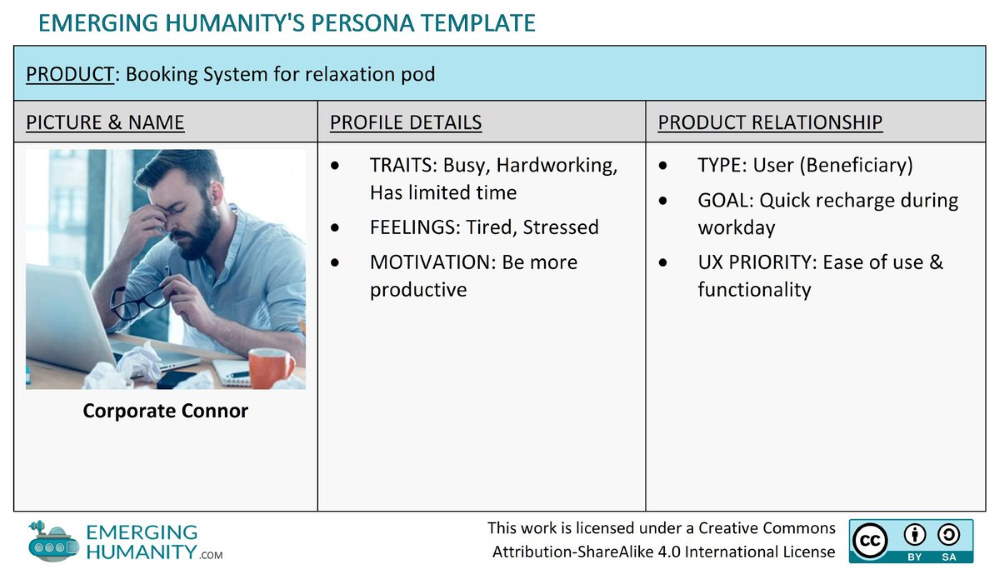
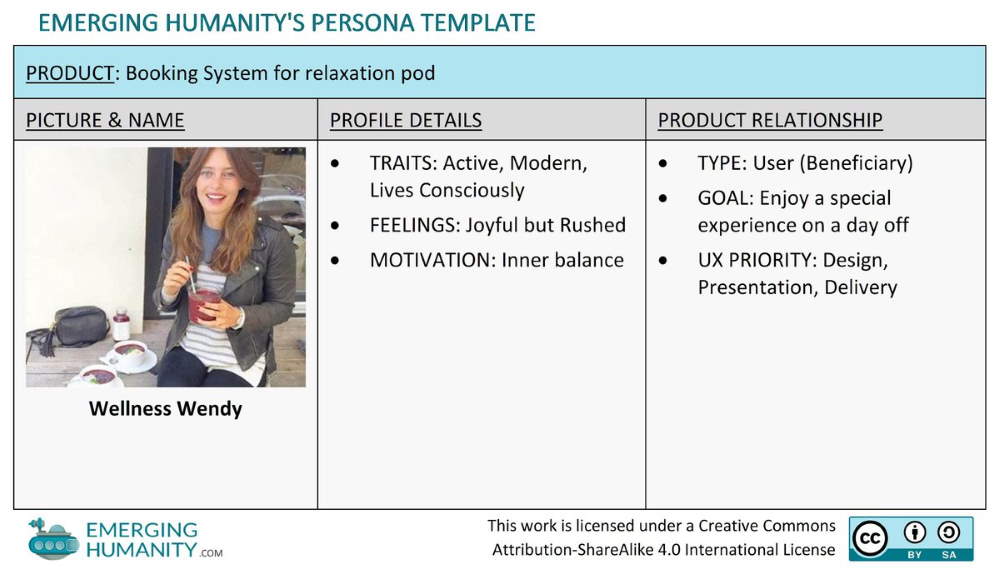
Here are two (simple) persona examples for a relaxation pod that users could find at an office or a spa:
What Makes a Good Persona
Creating a persona includes a good amount of research and some intuition. Fortunately, there are some useful guidelines.
A good persona
- Is realistic and not idealized
- Represents the current state and not the future
- Reflects patterns that have been observed from researching the market
- Describes or implies design challenges for the product to overcome
- Demonstrates users' behavior, context, needs, attitudes, goals and motivations, and challenges or pain points.
Personas in product development
Personas represent the voice of the user. As such, they play a critical role in Emerging Humanity's product design and development process. Failure to consider the typical activities and environment of the persona may result in creating an incomplete or disjointed product experience.
In the design process and in addition to personas, it is important to use scenarios to provide context and prioritize requirements. A good scenario will demonstrate potential uses of the product based on the goals and needs of the persona. This elaborates the relationship between the Persona and the product, and helps to overcome possible shortcomings in the design process.
When connecting the product to the end user, it is important to consider at least two scenarios to ensure optimal customer experience across different use cases. This approach allows product designers to validate design decisions, identify areas that require further work, prioritize product features, and create overall better products! Once your personas are built, the natural next step is to run each one through a Value Proposition Canvas to check the product actually addresses their real jobs, pains, and gains.
Frequently Asked Questions
How many personas should a startup have?
Most startups need two to four personas at most. More than that usually signals the segments are not different enough to warrant separate personas, or that the research has not converged on real patterns yet.
How is a persona different from a target audience?
A target audience describes a market segment in aggregate: age range, industry, company size. A persona narrows that down to one representative person and adds behavior, motivation, and product-specific pain points, which is what makes it usable for day-to-day product and design decisions.
Do personas need to be updated?
Yes. A persona built before market validation is a proto-persona and should be revisited once real user research is available, and again whenever the product or target market shifts meaningfully.




LEVEL UP YOUR STARTUP GAME
Articles · Workshops · Tips · Resources
We Help Visionary Tech Entrepreneurs Build Impactful Companies!